Thursday, July 30, 2020

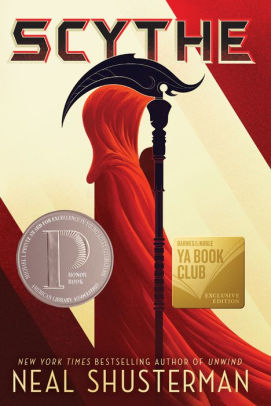
Scythe

Scythe
By Neal Shusterman
Read in 8th grade

Book 1 in series
Read book 2! Thunderhead (coming soon)
Read book 3! The Toll

    First book in Arc of a Scythe series. It takes place in a world past death, without disease or aging. Pain nanites can regrow limbs, and if you are killed in an accident, you are revived. There is no politics, because the world is taken care of by an AI called the Thunderhead. It keeps the world running, and every move is calculated so it is never wrong. Its mission: Protect humanity. At all costs. So how is the population kept in check if no one dies? Scythedom. This group is beholden to no laws, and the Thunderhead must stay out of its way as a part of its fundamental programming. These people go around and glean people, and can also grant immunity for a year. They can take whatever they want, and everyone fears/respects them. 
    One day, Scythe Faraday shows up at Citra Terranova's house and eats a meal. Afterward, he asks for a knife. Her family is terrified, but he gleans the person next door and grants Citra's mother immunity. Rowan Damisch is sitting at his friend Tyger's bedside after he splatted from hundreds of feet up. At school, Faraday shows up to glean the high school quarterback. Rowan stays with him for emotional support. Faraday notes his compassion. Later, he is ridiculed, accused of being with the quarterback for immunity.

TedEd: The art forger who tricked the Nazis


A TedEd by Noah Charney

In the strangest trial in Dutch history, a man's life depended on proving his work was a forgery. Han van Meegeren was an artist whose original works failed to make money. Angry toward his critics, he decided to make fools of them. He researched the old masters, their methods, their paints, their biographies. He decided to copy Johannes Vermeer, who was famous for his meticulous domestic scenes. Van Meegeren bought 17th century canvases, the pigments available in Vermeer's time, and created his own brushes. When he was done, he used synthetic resin and baked the paintings to make them look old. In his time, there were few forensic tests available to test the veracity of his paintings, and whether or not a painting was real was a matter of judgement by critics. Through research, van Meegeren found that many historians believed that Vermeer was influenced by Caravaggio in his early years. Luckily for him, the leading authority on Vermeer, Abraham Bredius, believed this theory and pronounced the paintings authentic. He sold forgeries for many years, making millions. When the Nazis invaded Holland, a German general wanted to add a Vermeer to his collection of stolen European art. So, van Meegeren sold him a forgery. But when the war was over, he was arrested for selling important pieces of Dutch history to the enemy. So in court, van Meegeren had to prove that the work was a forgery. He showed them the entire process, and escaped the death sentence - replaced with a 1 year sentence for forgery. After that, he became a sort of hero for swindling the Nazis, and his works gained a reputation of their own. So much, in fact, that he was later forged by his own son.

Tuesday, July 28, 2020

TedEd: The Infinite Hotel Paradox


A TedEd by Jeff Dekofsky

The Infinite Hotel Paradox was created in the 1920's by David Hilbert to show how difficult the concept of infinity is. Imagine a hotel with infinite rooms, all booked for the night. A person walks in and asks for a room. But you don't have to turn him down. You can ask every guest to move over one room, 1 to 2, 2 to 3, and so on until guest number n goes to room number n+1. Then the new guest takes room number 1. Now let's say that a bus with an infinitely countable number of passengers shows up. How do you fit all of them? If the guest in room 1 goes to room 2, 2 to 4, 3 to 6, and so on, each guest will move to room number 2n from n. This will fill all the even rooms, leaving an infinite number of odd rooms open. But now an infinite number of buses with an infinite number of passengers on each arrives. How do you fit all of those people? We can use Euclid's statement that there are an infinite number of prime numbers. So every current guest goes to the first prime number, 2, raised to the power of their current room number, so room 2^n. Then, the passengers on the first bus go to the next prime, 3, raised to the power of their seat number, or 3^n. The next bus, powers of 5, 7, 11, and so on to the last bus. Since each room is a prime to the power of a natural number, each one is unique, and there will be no overlapping rooms. This is only possible, however, with the lowest level of infinity, or the countable infinity of the natural numbers. This is 1, 2, 3 ... infinity. This is also called aleph-zero. With higher orders of infinity, though, our strategies fall apart. For example, the real number infinity hotel would have radical, irrational, and negative rooms. This all shows us just how hard the concept of infinity is.

National Geographic: Why weren’t we ready for this virus?

National Geographic: Why weren’t we ready for this virus?
By Robin Marantz Henig

We have missed many warning signs of the pandemic. Starting in the 1990s, scientists coined the term "emerging virus". It was first used by virologist Stephen Morse. He described modern conditions like urbanization and animal-human proximity that could release deadly pathogens that had never been seen before. He and others warned that globalization could then aid these diseases in moving around the world. Even though the warning signs were there, many doctors believed the next pandemic would be the flu. Why?
    It was easy to pretend something like coronavirus doesn't exist, and besides, it is very hard to track and predict the evolution of pathogens. Also, many didn't believe a global pandemic would be coming because, in our sheltered world, we saw viruses like SARS and Ebola mainly contained to their regions. It was easy to just say other countries were susceptible. We've dodged a bullet so many times that we became aloof, and this one brought humanity to its knees.