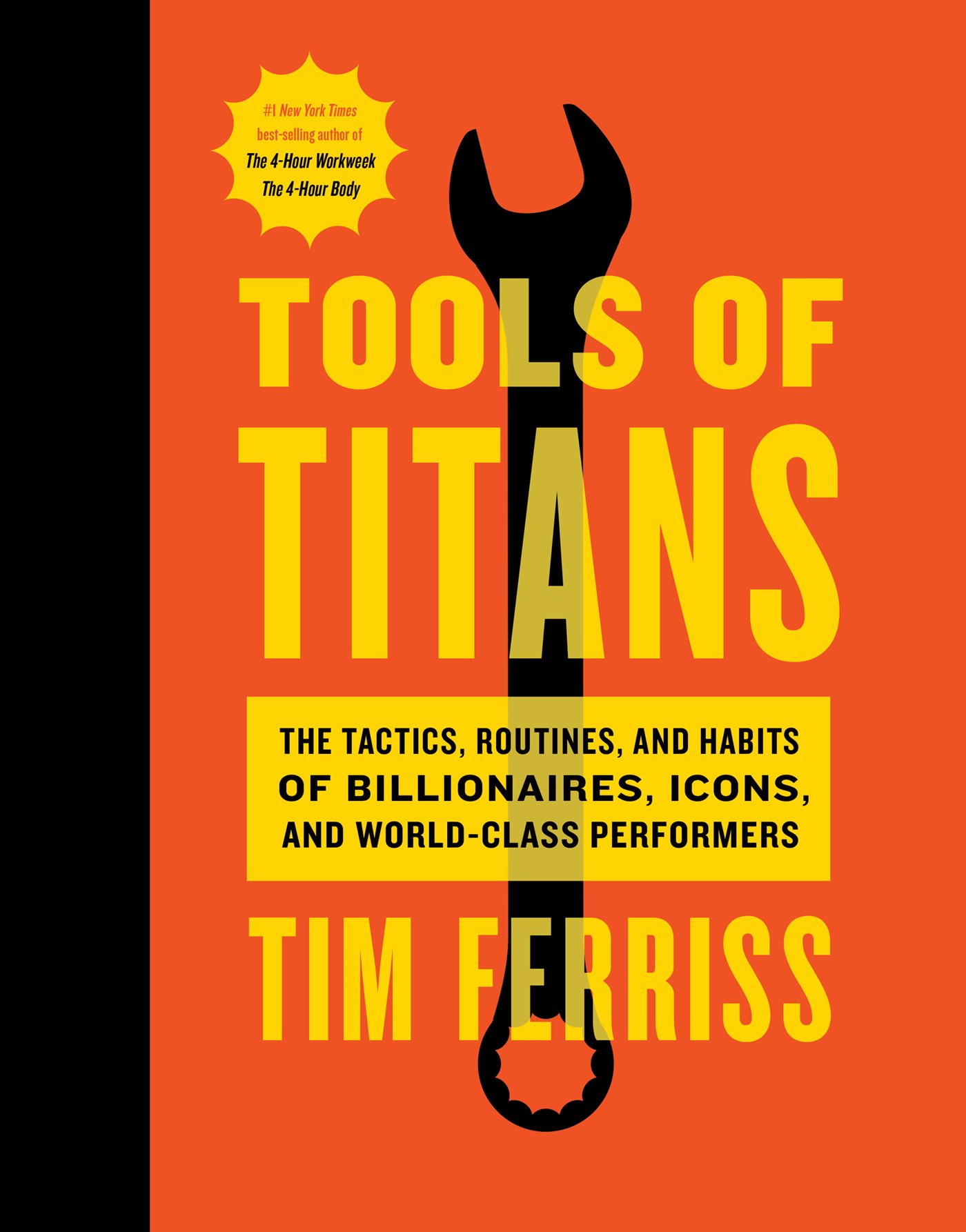
By Tim Ferriss
Warning: Very long
Tim Ferriss, the host of a show named after him, has interviewed
more than 100 famous people on his show to learn what they do and how they
achieved world-class performance. He has condensed hundreds of thousands of
hours of interviews down to no less than 736 pages in hopes of helping
others with tips from "titans".
In the introduction, Ferriss explains that all these people have certain characteristics in common. They ask the big questions and have uncommon habits. They believe failure is unsustainable and maximize strengths to compensate for weaknesses.
Part 1: Healthy
Amelia Boone: Boone is one of the world's most decorated obstacle course racers. She has amassed over 30 victories and won a championship 8 weeks after knee surgery. In addition, she is a full-time attorney and does some ultra running. Some tactics she employs are hydrolyzed gelatin with beetroot powder, a rumble roller (foam roller with protruding sections), dry needling, and saunas.
Rhonda Perciavalle Patrick, Ph.D.: She has done research on aging, cancer, mitochondrial metabolism, and apoptosis. She recently published a paper on vitamin D regulation of serotonin in the brain. In her interview, Dr. Partick talked about stem cells, which can be stored from baby teeth and wisdom teeth for later in life. In addition, hyperthermic conditioning, or calculated heat exposure can increase growth hormones and improve endurance.
Christopher Sommer: He is a former U.S. National Team gymnastics coach and founder of GymnasticBodies. His 40 years of observing top athletes allowed him to create the Gymnastics Strenght Training (GST). Here are some of the things he has learned. You should always work on the deficiencies you are most embarrassed by because it is the only way they will get better. Mobility, or strength through an entire range of motion, is better than flexibility. Consistency is better than sporadic intense training. The book also includes a variety of exercises, including the QL Walk, Ring Turn Out, Hinge Rows, and Ag Walk (Google it).
Dominic D'Agostino: He is an associate professor in the Department of Molecular Pharmacology and Physiology at the University of South Florida Morsani College of Medicine. His specialty is metabolic therapies, including ketone, which is what is described in this chapter. A ketogenic diet is a high-fat diet that mimics fasting, causing your body to use ketones for energy instead of glucose. This induces ketosis, which can be measured at less than 0.5 mmol of BHB in your blood. Ketosis can help you lose fat, prevent cancer, use oxygen better, and increase strength.
Patrick Arnold: Arnold is considered the "father of prohormones". He created the steroid THG and several others. Today, he is innovating ketone supplementation. Some legal performance enhancers that he finds useful are ursolic acid spray, which helps with body recomposition, exogenous ketone drinks for workouts, and metformin for antiaging.
Joe De Sena: He is the co-founder of the Death Race, Spartan Race, and several others. He has competed in a variety of grueling marathons and races and is also a strategic businessman. He started participating in insane competition events while working on Wall Street to get away from the hectic life there and created the Death Race in order to break people by making them do things they had never done before.
Wim "The Iceman" Hof: He is a Dutch world record holder with more than 20 total. His world records are related to extreme temperatures, hence the nickname "Iceman". Cold exposure can, in fact, be used to improve immune function, increase fat loss, and elevate mood.
Jason Nemer: Nemer is the creator of AcroYoga, which blends yoga, Thai massage, and acrobatics. AcroYoga requires two people, a base and a flyer, and they do what it sounds like. The base is usually more experienced and supports the flier.
Dr. Peter Attia: He is a former ultra-endurance athlete, and has conducted research on immune-based therapies for cancer at the National Cancer Institute. He often enters ketosis like the author, and he utilizes glute medius workouts to strengthen his lateral stability. It is surprisingly difficult, and he calls it the reverse thigh master. 5 blood tests he generally recommends are the APOE genotype, LDL particle number via NMR, the Lp(a) via NMR, OGTT, and IFG-1.
Justin Mager, MD: Dr. Mager has helped the author with many experiments, and he believes that people should look and care about themselves more often. With blood tests, they are just a snapshot of one moment, which does not reflect you as a person. Also, context matters when are "optimizing", so you have to understand what a test is actually supposed to show you.
Charles Poliquin: He is one of the best-known strength coaches in the world. He has trained gold medalists and all-stars in a variety of sports. One important thing he has learned is that your carbs need to be earned. To deserve carbs after a workout, you need to have sub-10% body fat or vertical separation in your abs. Another thing he has found is that to increase testosterone, cortisol needs to go down because they both require the same raw materials. When your body is stressed, it produces more cortisol, reducing testosterone.
Pavel Tsatsouline: He is chairman of STrongFirst, Inc., a former physical training instructor for the Soviet special forces, and currently a subject matter expert to a variety of U.S. military branches. He usually has a simple breakfast of only coffee. His specialty is kettlebell workouts, and two good warmups are halos and cossack squats. A full exercise might include a one-arm swing, Turkish get-up, and a goblet squat.
Laird Hamilton, Gabby Reece, and Brian MacKenzie: Hamilton is regarded as one of the best surfers of all time. Reece is a successful volleyball player, and MacKenzie is the founder of CrossFit Endurance. He challenges distance running and favors a more minimalist approach. The three of them also hold workouts that involve getting in the pool with dumbbells, then going from an ice bath to a sauna. They say you should learn to be assertive and go first.
James Fadiman: He has been involved with psychedelic research since the 1960s. He is often referred to as America's most respected authority on psychedelics. Please note that many psychedelics are considered illegal, and also have toxins if taken in high doses. Psychedelics essentially generate expressions of the psyche on levels not normally observable. They have been used by indigenous cultures for years to treat depression, remove anxiety, end anxiety, and more. Many psychedelics resemble a molecule called DMT and act as the naturally occurring serotonin. In any case, all of them should be administered in the presence of someone who can guide you and be used in safe doses.
Martin Polanco and Dan Engle: Polanco is the founder of Crossroads Treatment Center, which specializes in conquering powerful addictions. Engle is board-certified in psychiatry and neurology. He has researched traumatic brain injury and plant medicines. One type of psychedelic is ayahuasca. It is one of the "safer" ones, but spiritually, it is the equivalent of a brain surgeon. Afterward, you will be very open, and done properly, it can be a corrective experience. Ibogaine is a very strong psychedelic that has been used in Africa to treat addictions. It can be deadly for some people, and is definitely too strong for people who just want to explore the psychedelic experience.
Kelly Starrett: He is a performance coach who has trained CrossFit athletes and various world-class athletes. He likes to drink as little water as possible, usually with a little bit of salt, because while dehydration usually is not a risk, low sodium concentrations in the blood are an issue. A good test for mobility is the campfire squat test, and if you can't squat all the way down, you are missing full hip and ankle motion. The overhead squat is a good solution. He is a proponent of good sleep habits.
Paul Levesque: He is popularly known as Triple H, a 14-time world champion in WWE. His tip for avoiding jet lag is to do a quick workout as soon as you can after you get off the plane, because it helps reset your mind. In terms of goal setting, if you really want to achieve something, it should be a goal, not a dream.
Jane McGonigal: McGonigal is a research affiliate at the Institute for the Future, with over 10 million views on her TED talks. She has written on how games make us better, and even finds that Tetris has therapeutic effects.
Dr. Adam Gazzaley: He is the director of the Gazzaley Lab at UCSF, and the co-founder of Akili Interactive, a company developing therapeutic video games, and is also a co-founder and chief science advisor of Akili Interactive, a company that develops therapeutic video games. He acts as a scientific advisor to more than a dozen technology companies. When he hires people what he looks for is not a specific thing but rather, what it is that excites them.
Chris Sacca: Sacca is an early stage investor in dozens of companies including Twitter, Uber, Instagram, and more. His strategy in investing is going on offense. By this he means taking the time to focus and build what he really wants, rather than going from coffee to coffee, day by day. To do this, he bought a cabin near Tahoe. He also recommends attending as many high level meetings in your workplace as possible. It is a good way to start getting to know things and people higher up.
There are many more people who are included in this book (honestly I couldn't write them all out), but it all revolves around a few central topic that Ferriss end the book on. Always finding something positive in the situation, dealing with your fears, weaknesses, and biggest tasks first, and living a healthy lifestyle. It all contributes to being less stressed and having more freedom in your life to pursue what you want.