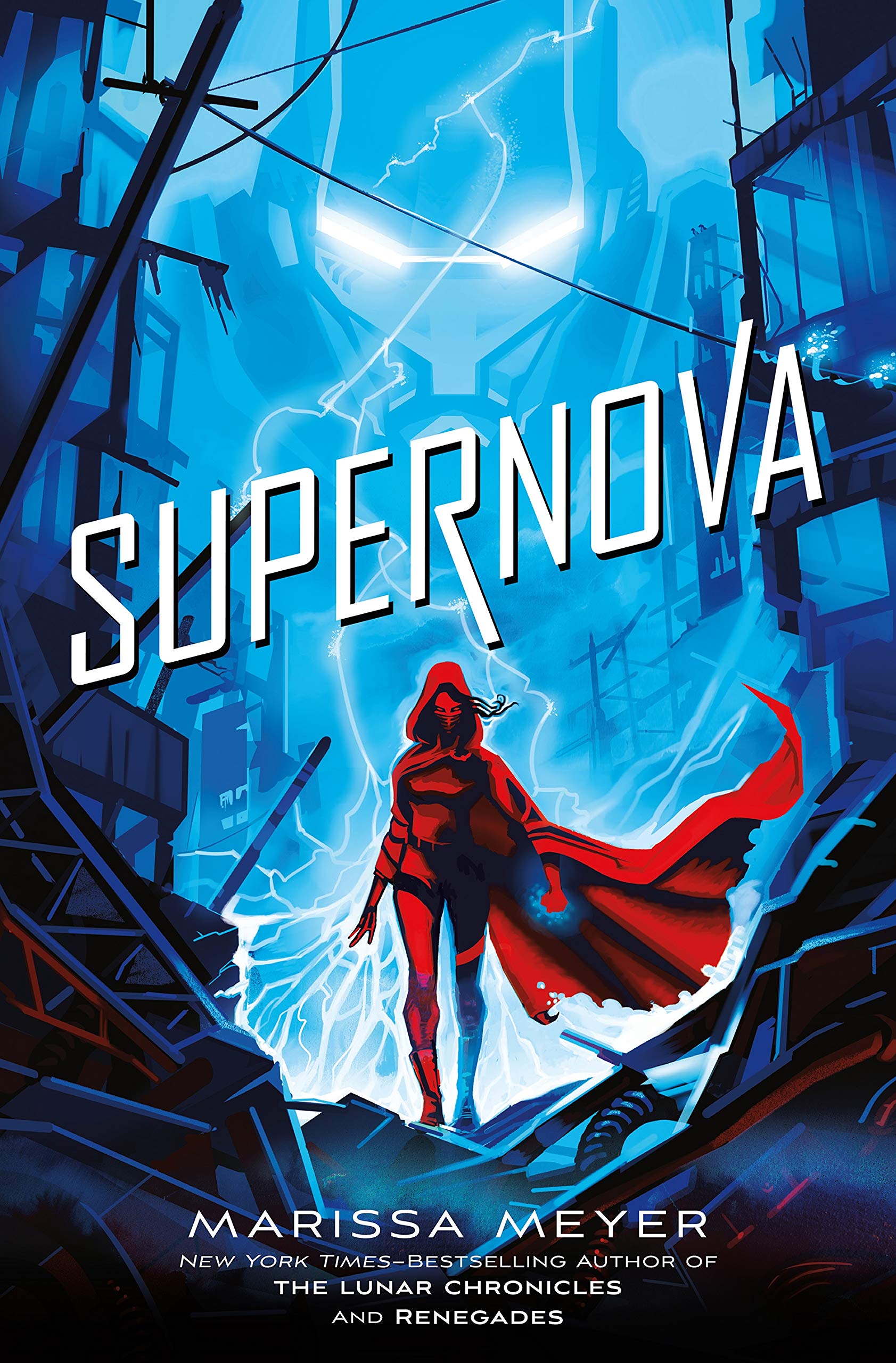
This is the third and final book in the Renegades series. Nova (Nightmare) returns to Renegade headquarters in her uniform the day after she destroyed it as an Anarchist, escaping with Ace Anarchy’s helmet only to find that the Renegades captured him. Adrian is furious because he thinks that Nightmare hurt Max, who is in critical condition, when it was really Frostbite, who accidentally stabbed him instead of Nightmare. He also finds it suspicious that she wasn’t affected by Max’s power.
After the nights’ events, the Council has decided to include Ace Anarchy’s neutralization and execution as part of the public reveal for Agent N. To make matters worse, Gennisa Clark and her team, who were neutralized by Nightmare, are mad at the Council, renouncing their development and use of Agent N.
We learn a lot of words over the course of our lives. By age 20, we know as much as 52,000. By age 60, we average between 35 and 56 thousand. Most words take less than a second to say out loud, and when we hear them, our brains have to make a split second decision on which word, out of the many thousands, it is. We are correct about 98% of the time. So how do we do it? One important part is that our brains can do many activities at the same time. Many scientists believe that each word in our brain is connected to a different neural network that identifies the likelihood of heard speech matching that word. These neurons are in the brain’s cortex. When we hear the beginning of a word, many of these units become active because many words can have similar beginnings. As the word goes on, the words that are missing crucial parts begin to go inactive, eventually narrowing down to one word. This often occurs before the end of the word, and the point at which one word is selected is called the recognition point. Most people can recognize up to 8 syllables per second. We also need to know the meaning of the word, and our brain accesses many different words/meanings during the word before settling on the correct one. Recognition happens more quickly when we are given context, especially with words that have multiple meanings or homophones. For multilingual people, they must also match the language they are hearing in order to eliminate incorrect words or meanings. But what happens when we learn new words? What prevents new neural patterns from erasing old ones? Scientists believe that to avoid this problem, new words go first to the hippocampus, the memory center of the brain, instead of the cortex so that words can’t overlap. Then when we sleep, the new words gradually transfer over with the old words, becoming part of our neural network.
After World War II, people lived in a constant state of fear during 45 years. During the Cold War, everyone knew that they could be wiped out with nuclear missiles at the push of a button. During this time, the US and USSR had a global face-off, each with enough nuclear weapons to destroy each other. And the closest it got was during the 13 days of the Cuban Missile Crisis. In 1961, the US attempted to overthrow the new Communist government of Cuba in an attack known as the Bay of Pigs (the Cold War was about Capitalism vs. Communism). It failed, and Cuba decided to get protection from Russia. The USSR sent nuclear missile to Cuba, both to protect the island and to down size the US missiles in Turkey and Italy. US intelligence agencies learned about the plan far too late, and an emergency meeting was held on October 16, 1962. Military leaders suggested an airstrike, but Kennedy didn’t want to be hasty. He announced that the US would be blocking all shipments to Cuba, except for necessities. This was because a full naval blockade was considered an act of war, while Kennedy could simply call it quarantine if necessities were allowed in. The Soviets didn’t like that, and 6 days of global terror ensued, with the US demanding the removal of missiles and the Soviets insisting they were only defensive. On October 27, a spy plane was shot down over Cuba. Then, a nuclear armed USSR submarine was intercepted by a US navy vessel. The sub was too deep to communicate with the surface, and since its commanders thought war had begun, they had to decide whether to fire a nuclear torpedo. It had to be a unanimous decision by its three officers. But one of them, Vasili Arkhipov, wouldn’t let the others launch. This decision may have saved the world. Still, the US was on DEF CON 2, a level of defensiveness one level from total nuclear war. Robert Kennedy and Anatoly Dobrynin held secret talks in Washington, and reached a deal - The USSR would remove its missiles if the US removed theirs and agreed not to attack Cuba. And the crisis was over. The decision was criticized at the time, saying that each side had bargained with the enemy, but today we admire the two leaders’ ability to diplomatically solve the crisis.
The Sun produces a lot of energy. The Earth gets as much as 173,000 terawatts of it every day. That’s 10,000 times more than the entire planet uses. So could we become entirely dependent on solar energy? A solar panel is made up of smaller solar cells. Each cell is typically made of silicon, a semiconductor. Silicon is put between two conductors. There are two types of silicon used - N and P. N type has extra electrons, while P is missing some. When photons from the Sun hit the solar cell, something called P/N Junction occurs. A photon with enough energy will knock an electron out of its spot, leaving a hole behind. Because of the electric field at the P/N Junction, the electrons will go toward the N silicon and the remaining spaces to the P. Then, the electrons run through a circuit, eventually returning to the P silicon to fill the holes. Because it cycles through, the solar cells don’t wear out, lasting for many years. Each cell only produces 1/2 volt, but many of them can be put together to make a solar panel. So why can’t the entire world run on solar power? There are many physical and logistical challenges to making that work. First, not all parts of the world receive enough solar energy. Also, clouds and nighttime make sunlight less readily available, so effective storage and movement of energy would be needed to make this work. Secondly, solar cells aren’t very efficient yet. If a photon is reflected, or an electron returns to a hole before going through the circuit, energy is lost. The most efficient solar cell so far only makes use of 46% of total available energy, and widely available ones are 15~20% effective. Still, with enough space and infrastructure, it would be possible. As much as hundreds of thousands of square miles of space would be needed, which isn’t actually very much. In fact, solar panels are already competing with electricity from the grid, and floating solar farms at sea could take things even further. There are also billions of developing communities, many of which have ample sunlight with little to no electricity who could benefit. But in places with many cloudy days or little daylight, solar power could be a little way off.