Wednesday, August 26, 2020

TedEd: Is the weather actually becoming more extreme?

A TedEd by R. Saravanan

In the past 40 years, the number of extreme weather events has been steadily increasing. But the question is, are these just bad weather patterns, or deeper changes to our climate? First, we should define the differences between weather and climate. Weather is defined as the atmospheric conditions at a specific point in time and a place. Right now, we can get fairly accurate weather predictions for about a week. Climate is the atmospheric condition in a region over a much longer period of time. Climate forecasts predict average weather patterns over time instead of specific types of weather. These two things are forecasted using different data sets. For weather, the conditions used are current precipitation, air pressure, humidity, and wind speed and direction. Twice a day, weather balloons with devices called radiosondes are released into the air to measure these conditions and transmit them to weather stations. Meteorologists can use this data in models that generate the forecast you see. The reason they are sometimes inaccurate is that weather is a chaotic system that is very sensitive to tiny details that are near impossible to have. Within just weeks, small changes in conditions can change weather patterns, like the butterfly effect. Climate forecasts are different, partially because they take an average of weather patterns and because they base their data on the range of possible outcomes. These boundary conditions constrain the possible weather and climate patterns. We can average these to get accurate climate models for years to come. The catch is that small changes to boundary conditions can make affect the chaotic weather systems. For example, the 1 degree celsius that the Earth's temperature has increased by has had the effect of 1M nukes in our atmosphere. These shifts do, in fact, increase the amount of extreme weather on our planet. This is what climate change is, but we can help combat it by examining changing boundary conditions and figuring out how to reverse our effects on the planet.

Tuesday, August 25, 2020

TedEd: Why can't you divide by zero?

A TedEd by the Ted team

In the mathematical world, one of the unbreakable rules is that you can't divide by zero. But why? Usually, dividing by increasingly small numbers results in bigger and bigger quotients (try it). So, if we keep getting bigger numbers by dividing with smaller numbers, it seems that dividing by 0 should become ∞, the largest number possible. However, we do not necessarily know this. All we know is that as the divisor gets closer to 0, the quotient gets closer to ∞, which is different from knowing x/0 = ∞. What really is division? If we say x/y, we can say how many times must we add y to get x, or y*z=x. Any time we multiply x by y to get z, we can see if there is a number that we can multiply z by to get back to x. That number is also known as the multiplicative inverse. The product of any number and its inverse is always 1. To divide by 0, we must first find its multiplicative inverse, which is 1/0. 1/0 would have to be 1 when multiplied by 0. However, x*0 is always 0, so 0 has no multiplicative inverse. But what if we broke some rules and defined 1/0 as ∞? Then, 0*∞=1, and (0*∞)+(0*∞)=2. We can rearrange the second equation to 0*∞=2. But we already defined 0*∞=1, so this is impossible. Now, we could define have all real numbers equal to 0, but that is pretty useless.

Sunday, August 23, 2020

CNN 10 8/24/2020 ~ 8/28/2020


Go to cnn.com/cnn10 for latest video

Monday, August 24, 2020
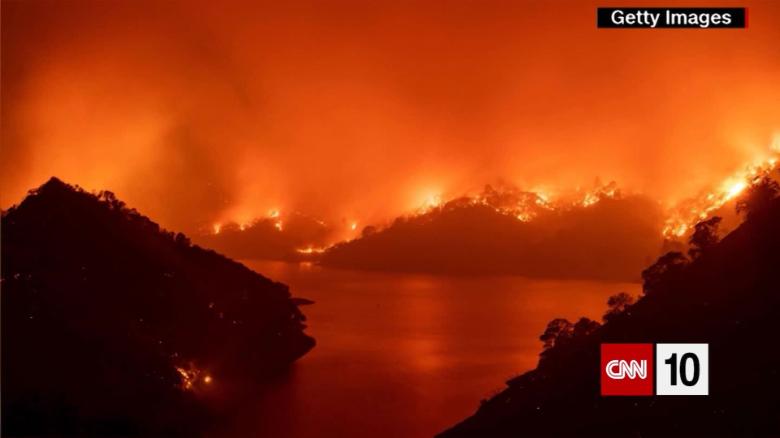
Last week, the Democrats held their National Convention, mostly online of course, and had their chance to promote their agenda. This week, the Republicans will hold their convention Monday through Thursday. Incumbent President and Vice President Donald Trump and Mike Pence will be nominated. In California, hundreds of fires are burning throughout the state after temperatures peaked and lightning hit multiple areas. Thousands of Cal Fire firefighters are attempting to contain the fire, but they need lots of help, more than they're getting. In fact, some residents decided to take matters into their own hands and prevent their homes from catching fire. COVID-19 has put many schools in a dilemma. Many of them are going virtual or hybrid, and colleges are being scrutinized over asking for full tuition fees. There have also been multiple cases of the virus due to sports or off-campus parties. Two asteroids have passed by Earth recently. One passed by at just 2000 miles, the closest ever, but NASA didn't know until it was gone. The most recent one is also pretty close, but the chances of it hitting us are less than a percent, and it won't do much damage.

The Immortal Life of Henrietta Lacks

The Immortal Life of Henrietta Lacks
By Rebecca Skloot

    In 1951, and African American woman named Henrietta Lacks went to Johns Hopkins hospital to get a pain in her cervix checked out. She apparently had cervical cancer, which was treated by radium at the time. Her tumor faded, and she went home. However, a cell culturist named George Guy had collected her cells without her consent - typical medical procedure at the time. And her cells became HeLa, the first ever immortal human cells. It eventually killed her, but the cells grew and grew - far beyond what her normal cells had ever grown to - and they were used for vaccines and other research, leading to huge advances in science. They were also a problem. They grew so fast and were so hardy that they contaminated many other cell lines, causing a minor medical crisis because that meant some studies were nullified. This all happened without her family knowing.
    After her death, her husband, Day, had signed some form that asked if "John Hopkin" could do an autopsy and collect some cells. He had no idea what that meant, but he signed it. Leading to a generation of hardship. The Lacks family eventually found out about the cells from a scientist friend who had been using them for a long time. They were infuriated that people had made money off the cells and they had never gotten a share. The men in the family tried to get money out of Johns Hopkins, but Deborah, whom the author of this book spoke to, just wanted to know about her mother and sister.