Tuesday, July 20, 2021

TedEd: The ancient origins of the Olympics

A TedEd by Armand D'Angour

In 776 BCE, the Olympic games first took place in the ancient Greek city of Olympia as a tribute to the Greek god Zeus. They believed that competition fosters excellence, so they held a variety of competitions like running, poetry, singing, and more. The first games began with the 200 yard dash, but the games quickly evolved to include boxing, chariot racing, the pentathlon, and other events. Then in 391 AD, during the Roman Empire, the Christian Roman Emperor Theodosius banned the Olympic games, ending the millenia long tradition. 1500 years later, in 1896, the first modern games began in Athens, Greece, bringing thousands of athletes from around the world together in the world's largest sporting event.

Sunday, July 18, 2021

National Geographic: How the Rosetta Stone unlocked the secrets of ancient civilizations

By Erin Blakemore

    In 1799, the Rosetta Stone was discovered in Egypt. But it wasn't an archaeological dig; instead, it was dug up by French soldiers creating defenses for an Ottoman attack. They tore down a nearby wall and found a stone fragment with three types of writing, including ancient Greek. Today, we know that it is an inscription affirming King Ptolemy V's royal cult.
    When the French invaded Egypt in 1798, they brought scientists and archaeologists with them to pick out objects of interest and take them back to France. But the British ultimately defeated the French for control of Egypt and took the artifacts, including the Rosetta Stone, to England, where it resides in the British Museum to this day.
    Scholars across Europe raced to decipher the stone, and notable contributions came from Thomas Young and Jean-François Champollion. Young, a scientist, looked at it as a mathematical problem. comparing other hieroglyphic texts to match phonetic sounds and piece words together. Champollion, who became known as the founder of Egyptology, cracked the code in 1822 by figuring out that the third script was demotic and the hieroglyphs were coptic.
    Eventually, more multilingual inscriptions were found, confirming this idea. But the iconic stele still generates controversy. Egypt has continually asked that the relic be returned, but it has adamantly remained in Britain, garnering 6 million visitors every year.

Saturday, July 17, 2021

TedEd: Could we build a wooden skyscraper?

By Stefan Al

Mjøstårnet is an 18 story tall building towering over the forests of Norway. But this isn't just any old building - it's the tallest wooden building on Earth. But even at the end of the 20th century, scientists believed a wooden building couldn't get over 6 levels. This is because regular lumber could handle forces parallel to its grain very well, but not forces perpendicular, meaning it couldn't withstand the weight of a tall building or the wind at high altitudes. However, the late 1800s brought about the creation of glue-laminated timber (glulam), and a century later, cross-laminated timber (CLT) was invented. In glulam, boards are stacked on top of each other and in CLT, layers are oriented opposite to each other. This meant glulam had significantly more tensile strength and CLT could withstand forces in both directions. These types of building materials can be made more easily than steel or concrete, and they are less likely to be permanently damaged in a fire. Additionally, they could help lower the 11% share that the construction industry has in global warming. Still, CLT and glulam are not as strong as steel and concrete, and require more wood than traditional construction. It's unlikely that they will be strong enough to support true 40-story skyscrapers, but even building up to 30-stories with a mix of steel and concrete could significantly lower our carbon footprint.

National Geographic: Why the U.S. once set off a nuclear bomb in space

By Brian Gutierrez

    On July 8th, 1962, the U.S. military prepared to launch a nuclear bomb miles into the air, a fusion bomb that was 500 times as powerful as the one that fell on Hiroshima. The bomb, Starfish Prime, would be one of the highest detonations ever and cause the nuclear powers to sign a treaty limiting the height of nuclear missile testing.
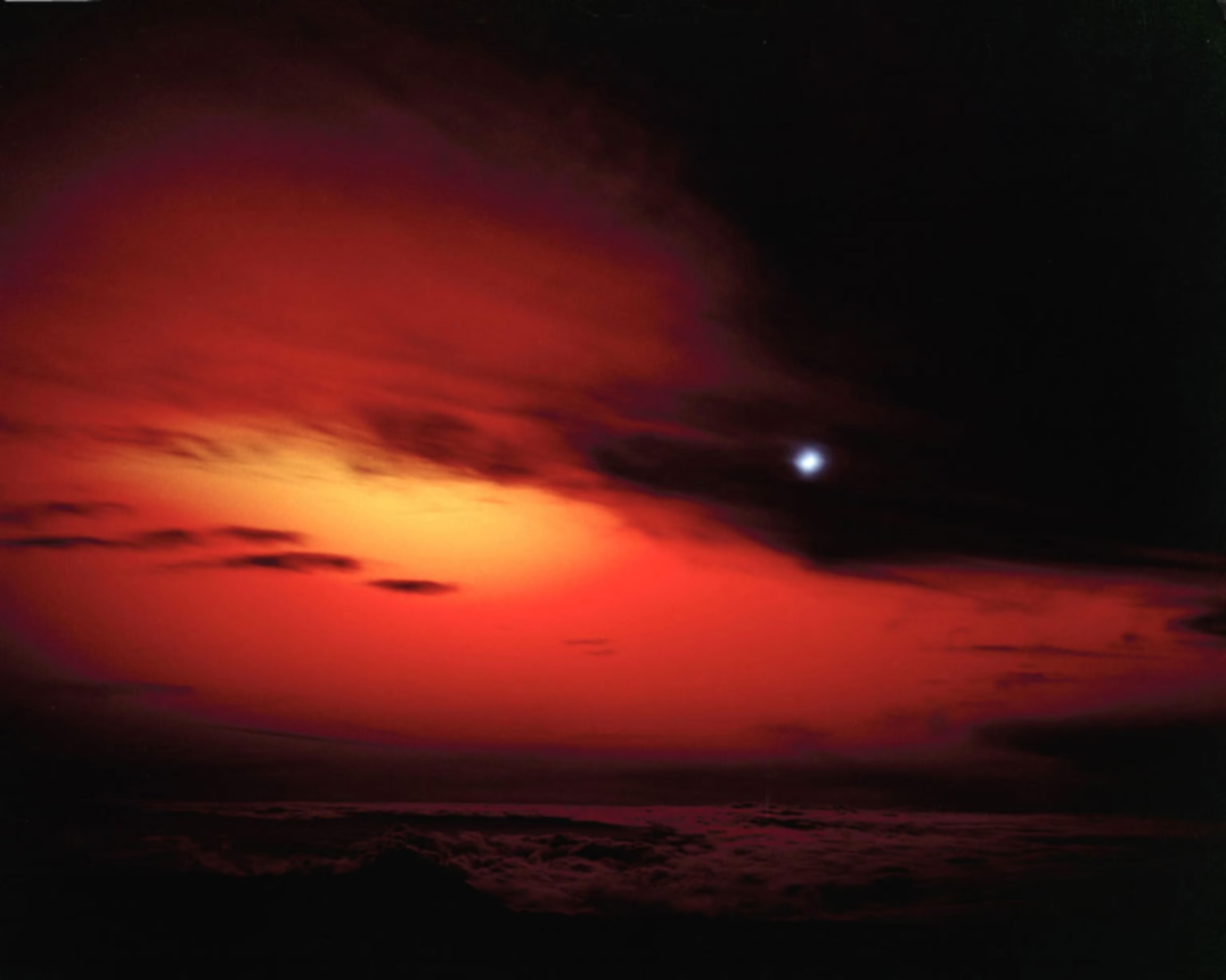
    Starfish Prime exploded at 250 miles into the atmosphere, around where the ISS orbits today. When it exploded above Hawaii, it lit up the night sky as far away as New Zealand, charged particles from the explosion colliding with the atmosphere and creating an artificial aurora. In Hawaii, it caused extensive blackouts, the collapse of the radio system, and made a siren go off.
    All this happened in the heat of the Cold War, when there were outlandish ideas like blowing up missiles on the Moon. Scientists were interested in knowing how the blast would interact with the Van Allen belts, which is essentially Earth's magnetic field. Most believed it would be a minor disturbance at worst.
    They were wrong. The massive plasma ball created a new radiation field called the Starfish Belt, with devastating consequences for the satellites that went through it. It eventually went away, but the threat of such an event occuring again is possible. Geomagnetic storms come periodically from the Sun, and if they are big enough, they have the effect of a nuclear bomb. In the 1800s, the Carrington Event created auroras in Australia and shocked telegraphers. But today, we rely much more on electronics than simple telegraphs. If the radiation is unchecked, the results could be devastating. Luckily, there is a potential remedy. If satellites hit the radiation belt with a certain frequency AM wave, the charged particles could be pushed into the atmosphere, where they would dissipate.