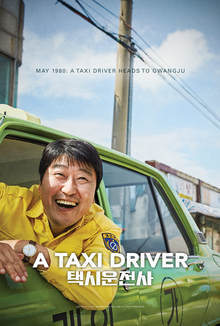
Based on a true story, this film captures the events of the 1980 Gwangju Uprising. It is centered around German journalist Jürgen Hinzpeter and his taxi driver, Kim Sa-bok (real identity unknown, he told Hinzpeter his name was Kim Sa-bok).
In 1980, widowed father Kim Man-seob (fictional name) returns home after a day driving around Seoul in his taxi. On the radio, he hears about protests by university students in Gwanju. He, like the majority of the populace, is being fed censored news that says more damage is being done to the military "protecting" the city than the protestors. He believes that the students should just study instead of doing all of this.
The next day, he overhears a corporate taxi driver talking about a foreigner who is paying 100,000 won for a trip to Gwangju and back before curfew. Man-seob slips away to steal the passenger, who is Jürgen Hinzpeter, a reporter from Germany who wants to know more about the uprisings in Gwangju. Because foreign media was restricted in Korea at the time by the military dictatorship of Chun doo-hwan, he pretends to be a missionary to get in.
Because the government has declared martial law, all the roads into and out of Gwangju are blocked, and the taxi driver tries to get Hinzpeter to go back to Seoul. He refuses to pay 100,000 unless he is taken to Gwangju, so they lie that he is a businessman to get in. Inside, all the roads are empty and littered with posters promoting democracy. Hinzpeter starts recording, and Man-seob repeats that the students shouldn't do this, Korea is a great place to live (in part due to government propaganda). They meet a truck full of students, and it is revealed that Hinzpeter is a reporter for ARD in Germany. The boys let him onto their truck, and Man-seob attempts to leave, afraid his taxi will be damaged in protests. However, he sees an old woman begging him to take her to the hospital; her youngest son has disappeared, and she fears that the police have beat him up. At the hospital, he runs into Hinzpeter, who scolds him and refuses to pay until the trip is over.
Hinzpeter and Man-seob take Jae-sik, one of the students, as a translator, and go to the site of the protests. The military fires tear gas into crowds of protestors, and mayhem breaks loose. While filming, Hinzpeter is spotted and they are nearly arrested. The taxi breaks down and is taken in for overnight repair by one of the local taxi drivers. Man-seob realizes that his young daughter will be at home alone and gets into a brief scuffle with Hinzpeter.
That night, the local TV station is blown up. When they go to record footage, a plainclothed security guard spots them, and they run into an abandoned building. Hinzpeter drops his film, and when Jae-sik goes to get it, he runs into a guard and gets killed while trying to buy time for Hinzpeter and Man-seob. He pleads with Hinzpeter to get the footage aired to the world before taking several blows. Man-seob is caught in a dead-end street, and the guard accuses him of being a Communist. Luckily, Hinzpeter is able to save him. In the morning, a taxi driver gives him a Gwangju license plate because the police are looking for a taxi from Seoul. He also gets a map of hidden passages out of Gwangju and gets away, stopping briefly at a bus station. There, he hears on the radio that protestors are causing chaos, and feeling guilty for leaving, he returns to Gwangju.
At the hospital, he finds Hinzpeter and the other taxi driver slumped next to Jae-sik's body. Man-seob reminds Hinzpeter of his promises to show the world what is happening and gets him to keep filming. Suddenly, more taxi drivers rush in, screaming that the military will kill them all. They are using real bullets this time, killing people on a closed-off street, and even those trying to get the wounded. Man-seob and the other taxi drivers create a blockade, helping the wounded get away. Afterward, they attempt to leave, but find even the hidden exits blocked by the military. Man-seob lies that Hinzpeter is a businessman trying to get away, and during a search of the taxi, a soldier finds his Seoul license plates in the trunk. However, he says nothing, letting them leave. The moment they leave, the head of national security gives an order to stop all foreigners, and several jeeps start chasing and shooting at the taxi. However, the local drivers intervene from a side road, sacrificing themselves to help Hinzpeter and Man-seob escape.
At the airport in Seoul, Hinzpeter asks for Man-seob's name and phone number, intending to return and pay him. After deliberation, Man-seob writes "Kim Sa-bok" and the phone number of a cigarette company. Hinzpeter thanks him for the ride, and leaves the terminal. He is later shown in Germany, airing the footage, while Man-seob returns home to his waiting daughter. When Hinzpeter returns and tries to find Kim Sa-bok, he realizes no such person exists.
Years later, Hinzpeter receives an award in Korea for his work in recording the Gwangju Uprising, and in his speech, thanks "Kim Sa-bok", saying that he has been searching for him and that he would really love to meet him again. In a newer taxi, Man-seob reads a newspaper article about Hinzpeter and says he feels the same.
As the final part of the movie, the real Jürgen Hinzpeter is shown thanking "Kim Sa-bok". Hinzpeter passed away in 2016, never seeing "Kim Sa-bok" again.