Saturday, October 3, 2020

National Geographic: What President Trump’s emergency COVID-19 therapies say about his condition

By Michael Greshko

    President Trump revealed that he had tested positive for COVID-19 on Thursday, and is now undergoing multiple treatments. While he has continually downplayed the severity of his condition, his medical staff and advisors have said that although his condition has improved, the next few days will be critical to his treatment.
    The president is currently on two drugs. One, developed by the US company Regeneron provides monoclonal antibodies, and the other, Remdesevir, has been shown to decrease the recovery duration in patients.
    Monoclonal antibodies are the Y-shaped proteins shown in the picture. They can latch on to the viral body's spike proteins and if enough of them get on it, it can prevent the virus from infecting cells. Regeneron's treatment, called REGN-COV2 is designed to prevent the virus from living in the nose and mouth so that it cannot reach the lungs. The drug is still in the early stages of testing and many medical professionals have been hesitant, using it only on a few special cases.
    The president is also scheduled to have a total of 5 doses of Remdesevir, a repurposed over-the-counter drug that has decreased recovery time in some patients.

Monday, September 28, 2020

CNN 10 9/28/2020 ~ 10/2/2020


Go to cnn.com/cnn10 for latest video

Monday, September 28, 2020
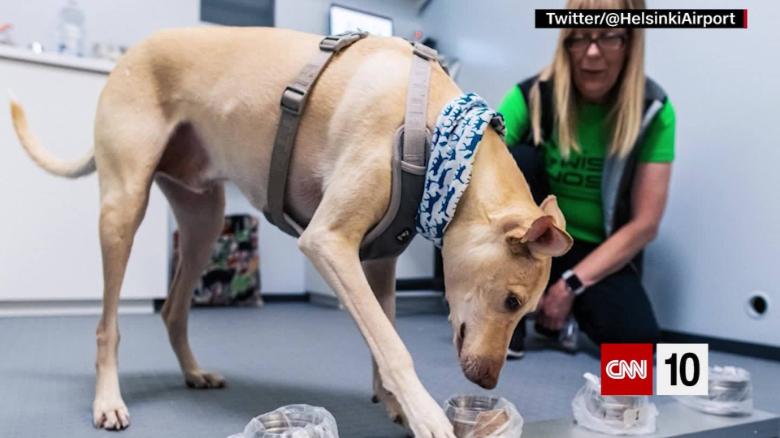
President Trump has nominated Amy Coney Barrett to become the next associate justice on the US Supreme Court. She currently serves on the 7th US Circuit Court of Appeals and teaches law at the University of Notre Dame. If she is confirmed by the Senate, she will replace former Associate Justice Ruth Bader Ginsburg, who passed away on the 18th due to complications of pancreatic cancer. The Senate is currently controlled by the Republican party. They want to vote on and confirm Judge Barrett as soon as possible, while the Democrats want to wait until after the election, in which they hope to gain more power. See last week for more information. In Helsinki, Finland, a new way of detecting COVID-19 is being tested. Researchers have trained dogs to sniff out the virus and are now going through a trial at the Helsinki airport with volunteers. The passenger swabs their skin, puts it in a cup, and the dog checks it for the virus. If successful, this could be rolled out across the country and the world. During these challenging times, a CNN Hero is helping senior citizens. Greg Dailey delivers newspapers as a part-time job, and when one of his customers was afraid to go out into to street to get her paper, he decided to start buying groceries for senior citizens for free.

Saturday, September 26, 2020

CNN 10 9/21/2020 ~ 9/25/2020


Go to cnn.com/cnn10 for latest video

Monday, September 21, 2020
Last Friday, associate Justice Ruth Bader Ginsburg passed away at the age of 87, and many memorials appeared outside the Supreme Court over the weekend. Justice Ginsburg had been battling pancreatic cancer since 2009, and in the Supreme Court's announcement of her death, Chief Justice Roberts praised her as a historic jurist and cherished colleague. She had served since 1993 when she was nominated by President Clinton, and she was a strong proponent of women's rights. She was considered a liberal Justice, and her death brings about much political controversy. Justices serve for life, and although there are no requirements for a nominee, presidents have traditionally picked highly qualified, sitting judges. Once a judge is nominated, they are questioned by the Senate Judiciary Committee and voted on by the Senate for confirmation. Because this is an election year, Republicans will probably try to get a nominee confirmed before November when they could lose the Senate and/or White House, and the Democrats will try to delay a vote as long as possible. In Colorado, an extinct type of apple is being brought back. The Colorado Orange apple was a key part of orchards when people originally settled the state during its gold rush. The last tree was found in an orchard in 2017, but there were no DNA samples of the apple to confirm that. However, Colorado State University had some wax models that matched the apples from the tree. It is now being grafted and given to orchard farmers.

Time: Honoring Ruth Bader Ginsburg: A Trailblazing Jurist Leaves a Vital Legacy

By Margaret Carlson

    Justice Ruth Bader Ginsburg died on September 18, 2020, at the age of 87 due to cancer complications. Before becoming a Supreme Court Justice, she led a campaign against sexism as a lawyer. She extended the 14th Amendment equal-rights clause so that women could get equal Social Security benefits, military housing allowance, administer estates, and serve on juries. She also implemented new terms, such as gender, "(so as not to distract male jurists with the word sex)".
    Ginsburg grew up in Brooklyn in 1933 and went to Cornell as a top student. There, she met Martin Ginsburg, her future husband, and the first man who "cared that [she] had a brain". After graduating, they both went to Harvard Law school. Unfortunately, Martin was called up to active duty, so she worked for the Social Security Administration in Oklahoma and even got demoted for working while pregnant. When they returned to Harvard, Martin came down with a type of testicular cancer, so Ginsburg had to write both their papers all while raising a child and being scorned by the dean for taking up a man's role. After her husband graduated, he got a prestigious job in New York, so she went with him to finish her degree at Columbia. It was this discrimination that influenced her future life as a lawyer.
    In 1993, President Clinton had a Supreme Court seat to fill, and although she wasn't at the top, Ginsburg made the list. She was not Clinton's first choice because of the fact that many women didn't see her as a feminist anymore - she did not make bold statements, instead slowly wearing down laws, and she was considered the stuff of yesterday. Luckily, Martin was great at publicity - he tirelessly worked to change her image and convinced the women that she was an adamant supporter of overcoming the patriarchy. She was confirmed in a 96 to 3 vote.
    Over time, she gained fame for her dissents - when the court tilted right, she read her dissents out loud in hopes that they would see their errors. Eventually, she gained recognition for everything she had done - memorials and merchandise were made for her, and she was awarded an honorary degree from Harvard Law.
    "Over the decades, Ginsburg quietly persisted—through discrimination, through Marty’s 2010 death, through more illness and debilitating treatments than any one person should have to endure—without complaint, holding on and out, until sheer will was no longer enough."